
New Braunfels, Texas · Slab foundations
Slab Foundation Repair in New Braunfels, TX
Piers, a careful lift and a plan drawn for the ground under your house.
Slab foundation repair puts support back under the parts of a concrete slab that have dropped. Piers go down through the moving soil, and the slab is lifted back toward level and held there.
Tell us what you're seeing
- Free inspectionIt costs nothing
- No obligationStopping after the inspection is fine
- Town-by-town soil dataFrom the USDA soil survey
- Referral service, disclosedWe pass requests to local pros
- Call (830) 500-5898Or send the short form
If you're reading this because a crack has opened or a door has started to stick, it helps to know you're far from alone in New Braunfels. About 69.3% of the city's homes were built in 1990 or later, and 40% of our USDA soil sample points landed on clay rated very high for shrink and swell. That's a lot of young houses on ground that moves.
When You Need Slab Foundation Repair
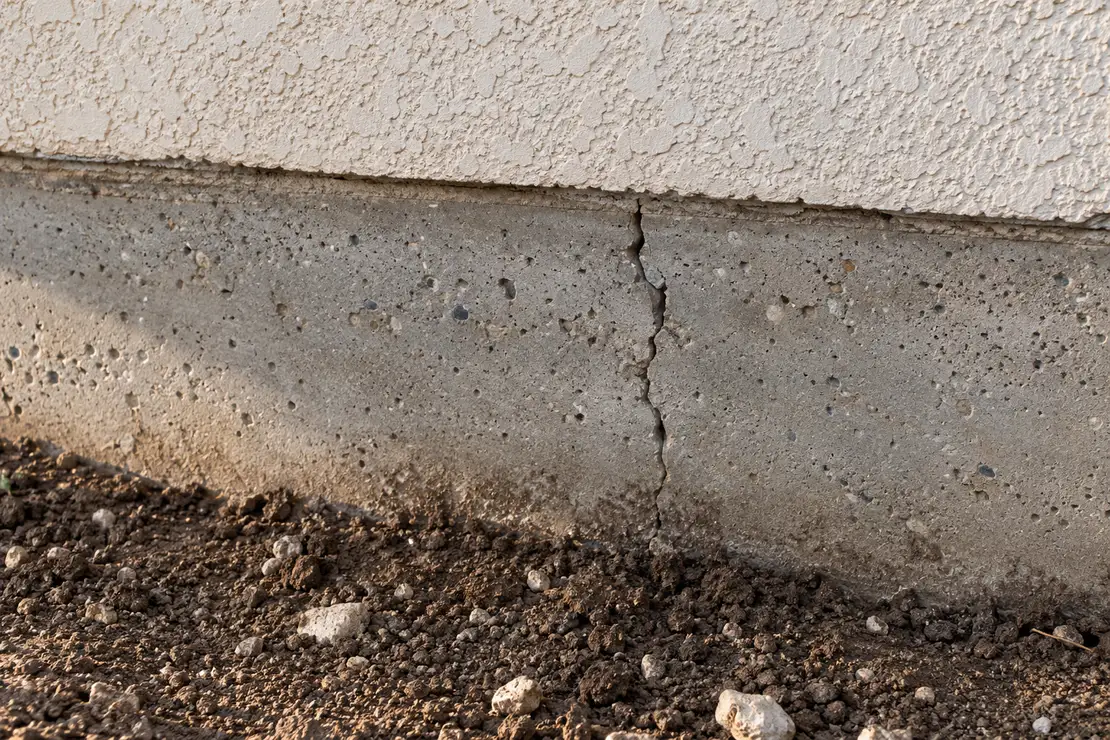
Plenty of cracks never need piers. The guidelines Texas engineers use say most cracks don't harm a foundation's strength. What points toward slab foundation repair is a pattern, not one crack:
- Doors that drag at one top corner, or gaps that open above them
- Stair-step cracks in brick or stone that are wider at one end
- Cracks running at a diagonal from the corners of windows and doors
- Floors you can feel sloping, or tiles cracking in a line
- A gap opening between the bottom of the wall and the slab
- Cracks that come back after they've been patched
HUD's housing inspection standard flags a foundation crack that's 1/4-inch or wider and 12 inches or longer. A crack that size is worth having someone look at soon. So is a crack that's clean inside, because HUD's inspection guide says a clean crack points to recent movement, while a dirty or painted-over one may be old news.
The last sign on the list matters most. A crack that keeps coming back is telling you the slab is still moving, and patching a moving slab means paying for the same fix twice.
What Slab Foundation Repair Involves
The steps run in a set order, and each one depends on the last.
1. Measuring the floors. A good assessment starts with relative floor elevations across the whole house. The guidelines Texas engineers use add those readings, and a scaled drawing of them, to what they call a Level B inspection. Without them, nobody knows which parts dropped or by how much.
2. A repair plan. In New Braunfels, the permit application needs a foundation plan that complies with chapter 4 of the 2021 International Residential Code. The Texas engineers' guidelines say repair documents should show a plan of the foundation, how each repair part is built, and the floor heights to work toward.
3. Installing the piers. The crew digs access holes along the settled part of the slab and drives piers down under it. With pressed piles, each one is pushed down using the weight of the house until it stops moving down and the house starts to rise. The Foundation Performance Association says the final depth varies from pile to pile, even on the same house.
4. The lift. The settled sections are raised back toward their old height. Shims go in right away. The same association warns that a piling can spring back if it isn't shimmed straight after it's driven.
5. Checking the work. After any lift, the Texas guidelines call for leak tests on the water and sewer lines under the slab, and for any leaks found to be repaired. They also call for a second floor survey to record where the house ended up. If an engineer was hired to oversee the job, they can issue a letter confirming it was finished as planned.
One honest note before any lift: the same guidelines say it's unlikely a repair will make a foundation perfectly level. The goal is solid support under the settled areas and a house that works again, with doors that close, not a perfect floor.
Slab Foundation Repair on Clay and on Limestone
This is where New Braunfels is different from most places. The city sits on the line between deep clay and thin soil over limestone, and the two call for different thinking.
On the clay side, the ground keeps going. Under Branyon clay, the USDA survey finds a very high shrink-swell layer from about a foot down to past 6 feet, with no rock in the top 80 inches. The Foundation Performance Association says piers that stop short of the zone where soil moisture changes can keep settling. So on Branyon or Houston Black, depth is the whole game. A pressed pier's depth comes from how hard it is to push, not from a guess.
On the limestone side, the rock is close. Comfort soil has bedrock about 13 inches down, and Rumple about 28 inches down. Steel piers can be pressed until they meet rock, which can happen quickly there. But a house on rock has far less soil beneath it to shrink, so if it's moving, it's worth looking hard for a cause like a plumbing leak or roof water pooling at one corner before anyone talks about piers.
Not sure which side you're on? Our guide to New Braunfels soil shows how to check your lot for free.
Post-Tension Slabs Need Extra Care
Many slabs in New Braunfels are likely post-tension, with steel cables pulled tight inside the concrete. The Post-Tensioning Institute says its design method for these slabs on expansive soil dates from 1980 and has been used on millions of homes. Since most New Braunfels homes went up after 1990, it's a fair bet that a lot of them have one. That's a trend, though, and not a fact about your house.
What matters during a repair is the cables. Concrete Network, a trade publication, describes a cable pulled to 33,000 pounds. It also warns that once a cable is cut, it's very hard to repair. Nobody should drill or core into a post-tension slab until they know where the cables run.
Many builders mark these slabs with a stamp, often in the garage floor near the door, and round patches along the slab edge can cover the cable ends. Our post-tension slab guide covers how to tell and what to ask before any repair.
Inside a post-tension slab
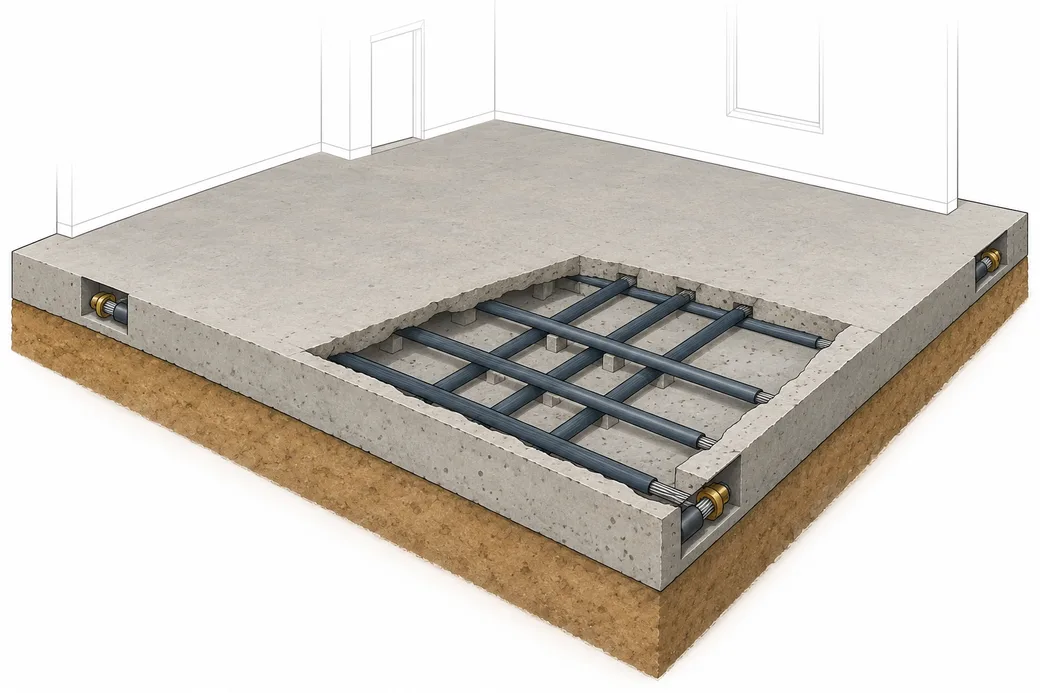
- Steel cables run through the slab in both directions
- Each cable ends at an anchor at the slab edge
- The slab is one piece, poured on the ground
What Slab Foundation Repair Costs
Published prices around New Braunfels vary a lot. One New Braunfels-area company lists $600 to $1,000 a pier installed. A national franchise's San Antonio office lists $1,500 to $3,000 for a steel pressed piling and $2,000 to $4,000 for a helical pier.
The number of piers moves the total most. The Foundation Performance Association has a spacing guide for outside piers. They go no more than 8 feet apart on a one-story house and 7 feet on a two-story with brick on the first floor only. On a two-story brick house, it's 6 feet. The guide also puts one at each corner, and one near the middle of any room 12 feet or more across.
Interior piers mean breaking out sections of the floor, so a job that stays outside is usually simpler. Our foundation repair cost guide works through why quotes vary.
Questions About Slab Foundation Repair
Do I need a permit for slab repair in New Braunfels?
Yes. The city requires a permit for any repair to a structure, and foundation is its own permit type. A registered contractor has to pull it, since the homeowner's exemption doesn't cover foundation repair. The application includes a foundation plan to chapter 4 of the 2021 International Residential Code.
Will piers stop my slab from heaving up?
Not usually. The Foundation Performance Association, writing about the Houston area, says the repair piers most often used on homes there aren't tied to the slab's beams, so they can't stop the slab from rising when wet clay swells. They hold it up. Keeping the soil moisture even is what limits the heave.
Will the cracks close after the lift?
Some will, partly. A lift brings sections back toward their old height, which can narrow cracks in drywall and brick. It's wise to plan on some patching and paint afterward. Most contractor warranties exclude finishes like drywall and brick, according to the Foundation Performance Association.
My house is new. Is there any paperwork on the slab?
Possibly. A 2022 city notice says New Braunfels asks for an engineer's foundation inspection letter during the inspections for new homes. If your home was built recently, ask the builder or the city for the project record. It may help whoever looks at the slab now.
What should a written quote include?
The Foundation Performance Association suggests the contract list the number and types of piers, any concrete breakouts, the price, payment terms and the warranty terms. Ask for the pier depths and a final floor survey too.
Related Services
- Foundation inspection to measure what the slab is doing before anyone prices piers.
- House leveling when the whole house has gone out of level, not just one corner.
- Foundation crack repair when the question is whether a crack is cosmetic or a sign of movement.
Towns We Serve
Slab repair looks different across the area, from the clay around Converse to the rock near Canyon Lake. We serve New Braunfels, Seguin, San Marcos, Kyle, Garden Ridge, Schertz, Cibolo, Selma, Universal City and Live Oak. See all service areas.
Get a Free Slab Inspection in New Braunfels
Let us know what you've noticed, and we'll pass it to a foundation repair professional who works in your area. They'll take a look and talk you through what they find. It costs nothing, and there's no obligation.
Tell us what you're seeing